October 23, 2026 | SAPTARSHI SAMANTA | 6 min read
freelance freelancing business management tool
India’s freelance and gig economy is growing at an extraordinary pace. But behind the headlines lies a quieter, data-backed story: freelancers and small agencies are losing time, money, and clients to broken processes.
This blog digs into the research numbers that define the day-to-day reality for Indian freelancers and agencies—and explores what can be done about it.
India’s Freelance Economy Is Booming
The scale of India’s independent workforce is staggering. According to the CII ETS India Skills Report 2026, India is home to 12–15 million freelance workers, a number projected to touch 23.5 million by 2029–30.
The demand side is shifting too. As reported by the Economic Times, project-based hiring in India rose 38% in FY25 as organizations increasingly prefer independent professionals over full-time hires for specialized work.
More freelancers. More projects. More opportunity. But also: more administrative complexity.
The Admin Tax: A Third of the Working Week Lost
The biggest hidden cost of freelancing is not client acquisition—it is administration.
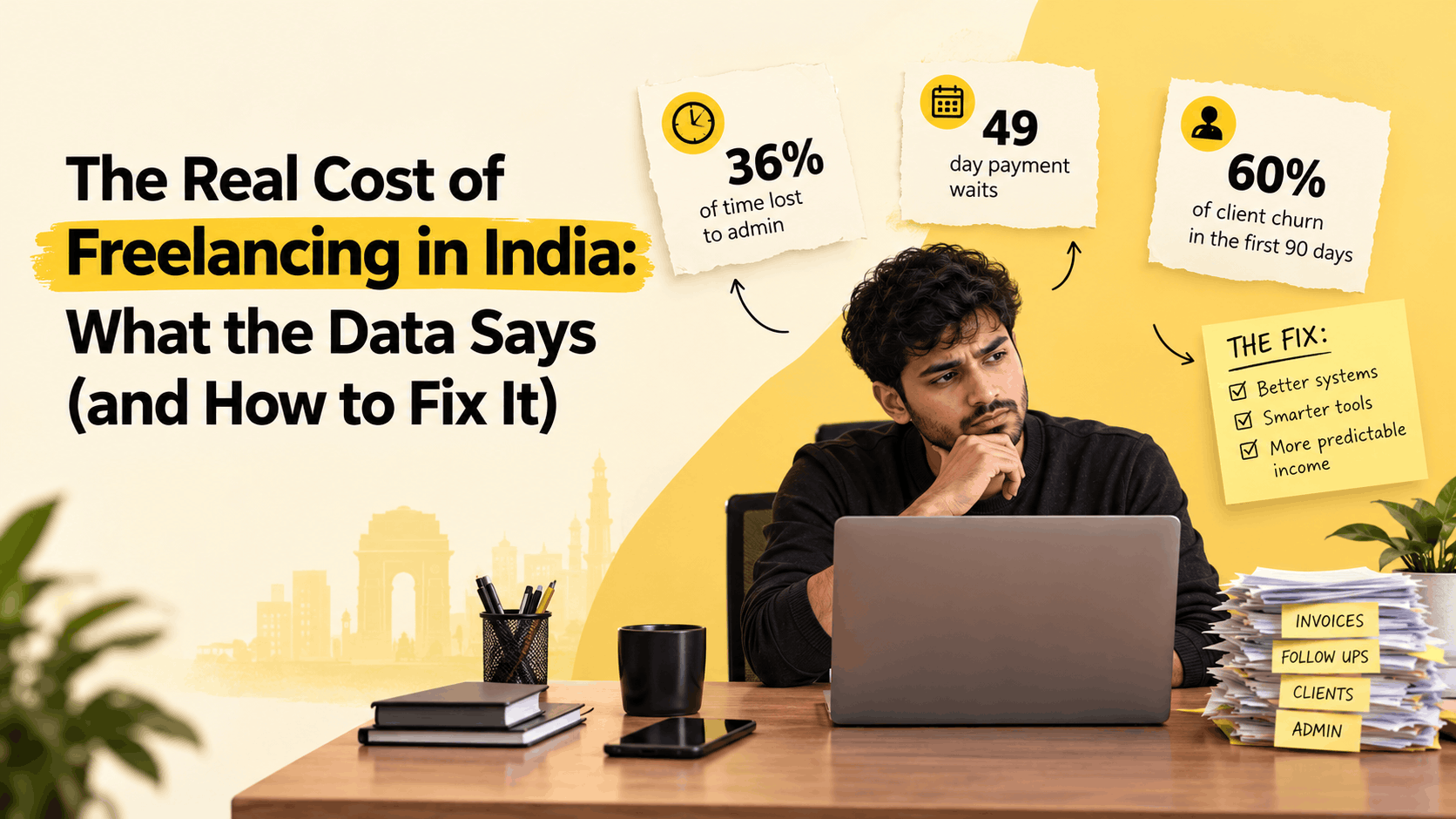
A survey of more than 250 entrepreneurs, reported by Forbes and conducted by Time Etc, found that business owners spend 36% of their working week on administrative tasks such as invoicing, data entry, and operations. For someone working 45.5 hours a week, that translates to more than 16 hours of admin—time that never appears on an invoice.
The freelancer-specific data is equally stark. The 2026 Smallpdf Freelancer Freedom Index found that freelancers lose an average of 204 hours a year to admin and paperwork, even with AI tools available. More than half say this admin burden costs them potential income.
The takeaway: The average freelancer is running a business on a part-time schedule—because the other part is consumed by running the business.
The Late Payment Crisis: Weeks of Waiting and Lakhs Lost
If admin work is the slow bleed, late payments are the acute wound.
Freelancers worldwide wait an average of 37–42 days after invoicing to get paid. In India, the figure is closer to 49 days, according to reporting by Medium on freelance payment trends. Separate research by Stackivo suggests the average Indian freelancer waits 47 days on a Net-30 invoice—and that switching to Net-7 terms can cut the payment cycle by roughly three weeks.
The scale of the problem is enormous. India’s freelancers are estimated to lose ₹1.2 lakh crore a year to unpaid invoices, according to analysis shared on LinkedIn. 85% of freelancers deal with late payments at least some of the time, and roughly 55% of invoices are paid late in India, according to the Global Freelance Payment Delay Index.
The cost is not just financial. ClientCasa reports that freelancers spend an average of 8–12 hours per month chasing late payments—time that is neither billable nor productive. Many turn to credit cards or short-term loans to bridge the gap, paying 1.5–3% monthly interest on earnings they have already delivered.
The takeaway: A late invoice is not a delay. It is a tax on the freelancer’s time, cash flow, and mental bandwidth.
The Onboarding Churn Problem: Most Clients Leave Early
Winning a client is hard. Keeping them should be easier—but the data suggests otherwise.
Between 60% and 70% of annual agency churn happens in the first 90 days of engagement, according to a 2026 agency churn analysis from Focus Digital. 23% of clients cite poor onboarding directly as the reason they churn, according to research from Wyzowl.
Yet only 29% of professional services firms have a standardized onboarding process, according to Gallup research cited by The Happy Hive Co. Firms that complete onboarding in 5–7 days retain 92%+ of new clients at 90 days, compared with only 70–80% for firms taking two to three weeks, according to Starward Navigators.
The takeaway: A slow, manual onboarding process is not just inconvenient. It is a churn engine.
The Proposal Follow-Up Gap: Most Deals Are Lost to Silence
Many freelancers lose revenue not because their work is poor, but because their follow-up is nonexistent.
60% of deals require serious follow-up, according to analysis discussed on The Fractional CMO Show. Research published in the Harvard Business Review and cited by Swydo found that 40–60% of qualified B2B opportunities are lost to “no decision” rather than competitors.
Meanwhile, 68% of B2B leads are never followed up properly, according to analysis shared on LinkedIn.
The takeaway: The gap between a lost deal and a closed one is often not talent. It is process.
The GST Compliance Burden
For Indian freelancers above the ₹20 lakh turnover threshold (₹10 lakh in special-category states), GST compliance is mandatory, and most professional services carry an 18% GST rate, as confirmed by Skydo and Angel One. As of 2025, 2.1 crore self-employed professionals were registered for GST, according to GST Network data cited by Calcwise.
Compliance is not just a tax cost—it is a time cost. For freelancers already losing hundreds of hours a year to general admin, GST adds another layer of unbillable work.
The takeaway: GST compliance is non-negotiable, but the hours spent on it are not.
What the Data Actually Points To
Across every metric—admin time, payment delays, onboarding churn, proposal close rates, and compliance burden—the same pattern emerges: freelancers and small agencies are losing money not because they lack skill, but because their operations are fragmented.
When invoicing, onboarding, proposals, signatures, and client communication live in different tools, every handoff introduces delay, error, and lost time. The data shows that firms finishing onboarding in 5–7 days retain 92%+ of clients, compared with 70–80% for firms taking two to three weeks. It shows that most B2B leads are never followed up properly. And it shows that admin work, when left unaddressed, consumes more than a third of the working week.
The solution is not more hustle. It is consolidation: bringing the core operations of a freelance business—clients, documents, invoices, signatures, and follow-ups—into one connected system, so that each step feeds the next instead of creating another manual task.
The Bottom Line
India’s freelance economy is projected to reach 23.5 million professionals by 2030. The opportunity is real. But the operational drag is real too—and it is measurable in hours, rupees, and lost clients.
The freelancers and agencies that thrive over the next five years will not be the ones who work the most hours. They will be the ones who build systems that give those hours back.