September 5, 2026 | SAPTARSHI SAMANTA | 7 min read
"client portal for Indian freelancers" "client portal India" "freelancer portal software India" "GST invoicing portal" "client portal WhatsApp"
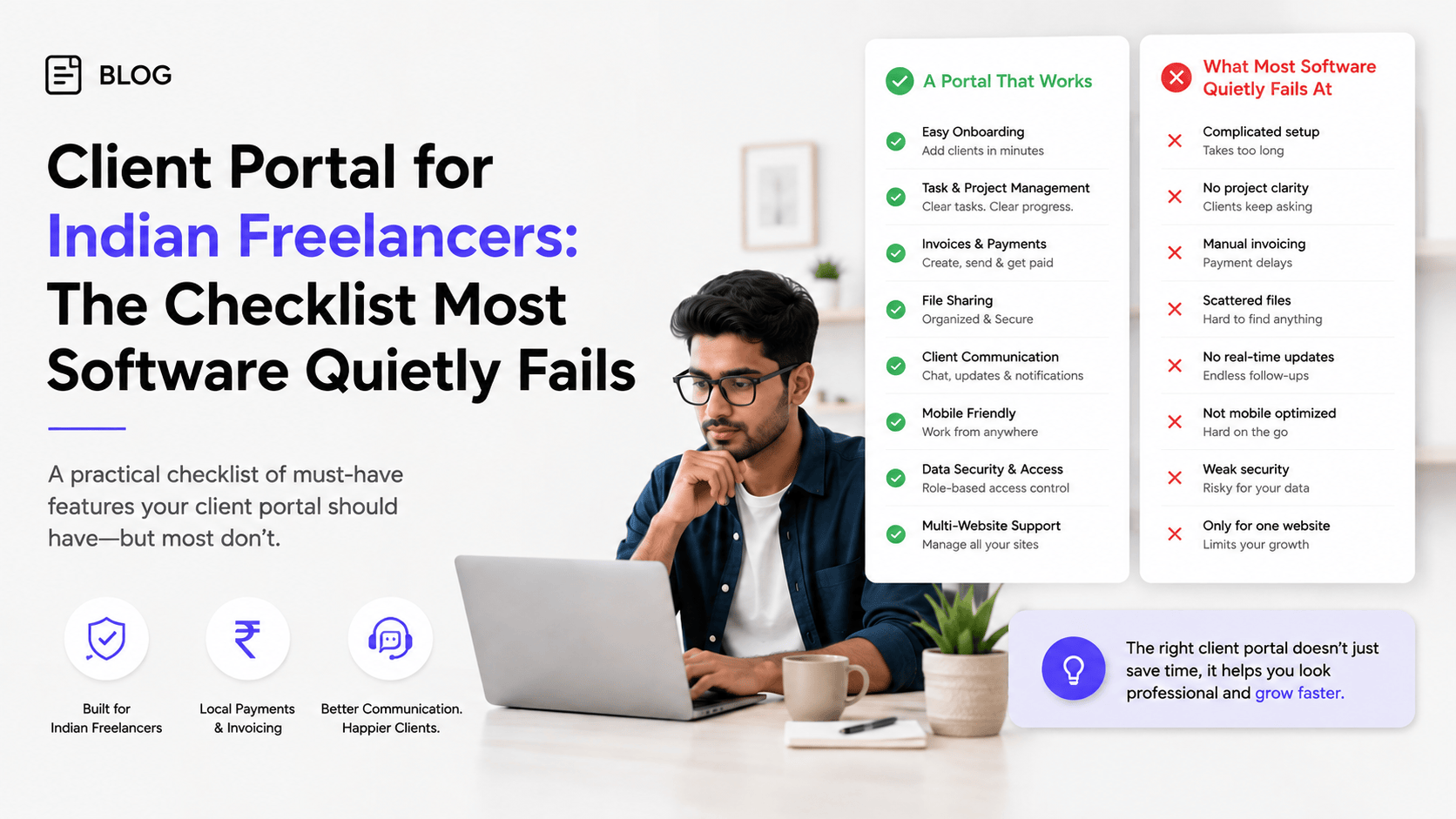
Client Portal for Indian Freelancers: The Checklist Most Software Quietly Fails
Search for a client portal for Indian freelancers and read the results with one question in mind: where does this software think you live?
The pricing page answers in dollars. The invoice template has a field for a ZIP code and none for a GSTIN. The payment integration leads with Stripe, the contract templates cite American law, and the cheapest plan converts to more rupees a month than your electricity bill. None of this is malice. The tools were built where their builders live, and their builders bank in a different country. But it means the obvious solution to a very Indian set of problems arrives shaped for someone else's, and freelancers here end up renting software that fights their actual week.
Worth pinning down what the thing is before arguing about where it should come from.
One link where the whole engagement lives
A client portal is a page you give each client. On it: the scope you both signed, the tasks with their current status, the files, the conversation, and the invoices with what's paid and what's due. One login for them, one for you, and the entire relationship in a place neither of you can lose.
The case for one is scattered across this series, so in brief. Deals here run on memory and chat threads, and I opened this series with a survey of 1,728 freelancers in which 74% had been paid late or never; the proof problem behind that number is what a portal exists to fix. A page a client can check at 11pm answers the anxiety that otherwise arrives as Monday's sharp email. A visible scope is what makes "that's extra" a fact instead of an argument. And the same study that found the average late payment takes 98 days to collect also found nearly everyone chases by repeated phone call, which is what happens when the invoice lives nowhere the client can see.
None of that is unique to India. What follows is.
What a client portal for Indian freelancers actually has to do
Five requirements, and they're worth treating as a pass-fail test when you evaluate anything.
Raise a GST-correct invoice, not an invoice-shaped document. If you're registered, Rule 46 dictates the fields: your GSTIN and theirs, SAC code, place of supply, sequential numbering within sixteen characters, the tax broken out properly. I walked through the full list in the invoicing piece. A portal that generates pretty PDFs missing those fields hasn't automated your billing; it's automated the reason accounts departments park bills. And your client's accountant cares about this more than your client does, which is exactly why it decides how fast you get paid.
Understand that money arrives in parts. Indian freelance payments are advances, milestones, part-UPI-part-transfer, the 50% deposit this series keeps recommending. Software built around a single card charge treats a part payment as an error state. The portal has to show a running tally, paid against due, per project, because a client who can verify what they've paid stalls far less than one taking your word for it.
Carry a signature that stands up here. Electronic signatures have legal weight under the IT Act, 2000, with a short list of exceptions that doesn't include work briefs, as covered in the contracts piece. The signed scope needs to live beside the work it governs, timestamped, where neither side can claim they never saw it. A tool whose e-sign flow is an afterthought bolted to a US contract library misses the point twice.
Coexist with WhatsApp instead of pretending it away. Every foreign tool assumes the client will faithfully log in and message there. Your clients live on WhatsApp and will not stop, and the boundaries piece argued they shouldn't have to; chat is for warmth, the room is for truth. The realistic workflow is chat for the quick yes, portal for anything with a date, a price or a file on it, and a ten-second habit of logging settled decisions where they can be found in six weeks. A portal that demands to be the only channel will simply be abandoned, by them first and then by you.
Cost like it was priced for this market. A 39-dollar plan is over 3,000 rupees a month at current rates, every month, forever, against freelance incomes that NITI Aayog's gig economy report projects will be spread across 23.5 million workers by 2029-30, most of them nowhere near Bangalore-agency rates. Tool cost has to sit against the real hourly rate maths from earlier in this series: if the software doesn't pay for itself inside an hour of recovered admin a month, the subscription is decoration.
The quieter localisation nobody lists
Beyond the checklist sit two subtler fits.
Terms and the law around them. An Indian portal can hold your payment terms against the reality that, with Udyam registration, the MSMED Act caps payment at 45 days regardless of what was negotiated, a lever I covered in the deposits piece that exactly zero foreign tools have ever heard of.
And the TDS gap. When 45,000 lands against a 50,000 invoice, a US tool sees a short payment and starts dunning your client. An Indian freelancer needs the record to reflect what actually happened, tax deducted at source, reconcilable against 26AS at filing time, per the invoicing piece. Small thing, until March.
When you don't need one at all
Honesty clause, same as ever in this series. Running one or two clients at a time, you can do all of the above with a folder per client, a numbered invoice template, a free e-sign tool and some discipline. Plenty of careful freelancers do, for years.
The break point is concurrency. Around three live clients, the folder system starts leaking, which brief goes with which bill, where the approved version went, whether invoice 31 was paid, and the context-switching piece put numbers on what that leakage costs. A portal earns its fee at the moment your memory stops being a reliable database, and not a month before.
Where Techostop sits in this
Techostop is the tool this series comes from, and it was built against exactly the checklist above, because its builders bank where you do. GST-ready invoicing with part payments tracked, e-sign that holds under the IT Act, and client rooms with chat inside them, so the record and the relationship stay together. A public profile with booking covers the front of the funnel, team payroll and leave sit in the same login for the day your first hire arrives, and pricing starts at 299 rupees a month, under one billed hour for almost anyone reading this.
Evaluate it against the five tests like anything else. The free account exists so you can.
The assumption test
Every tool carries assumptions the way a house carries plumbing, invisible until something backs up. Software assumes a country: a currency, a tax regime, a signature law, a way clients prefer to talk.
You can spend your working life translating around someone else's assumptions, pasting GSTINs into notes fields and explaining to dunning emails about TDS. Or you can pick tools whose assumptions match the place your clients, your invoices and your disputes actually live. A client portal for Indian freelancers is not an American portal with the prices converted. It's a different checklist, and now you have it.