August 23, 2026 | SAPTARSHI SAMANTA | 7 min read
project management software for Indian freelancers" "freelancer project management India" "task management freelancer" "Trello for freelancers" "client project tracking
Project Management Software for Indian Freelancers: Why Your Third Abandoned Trello Board Isn't Your Fault
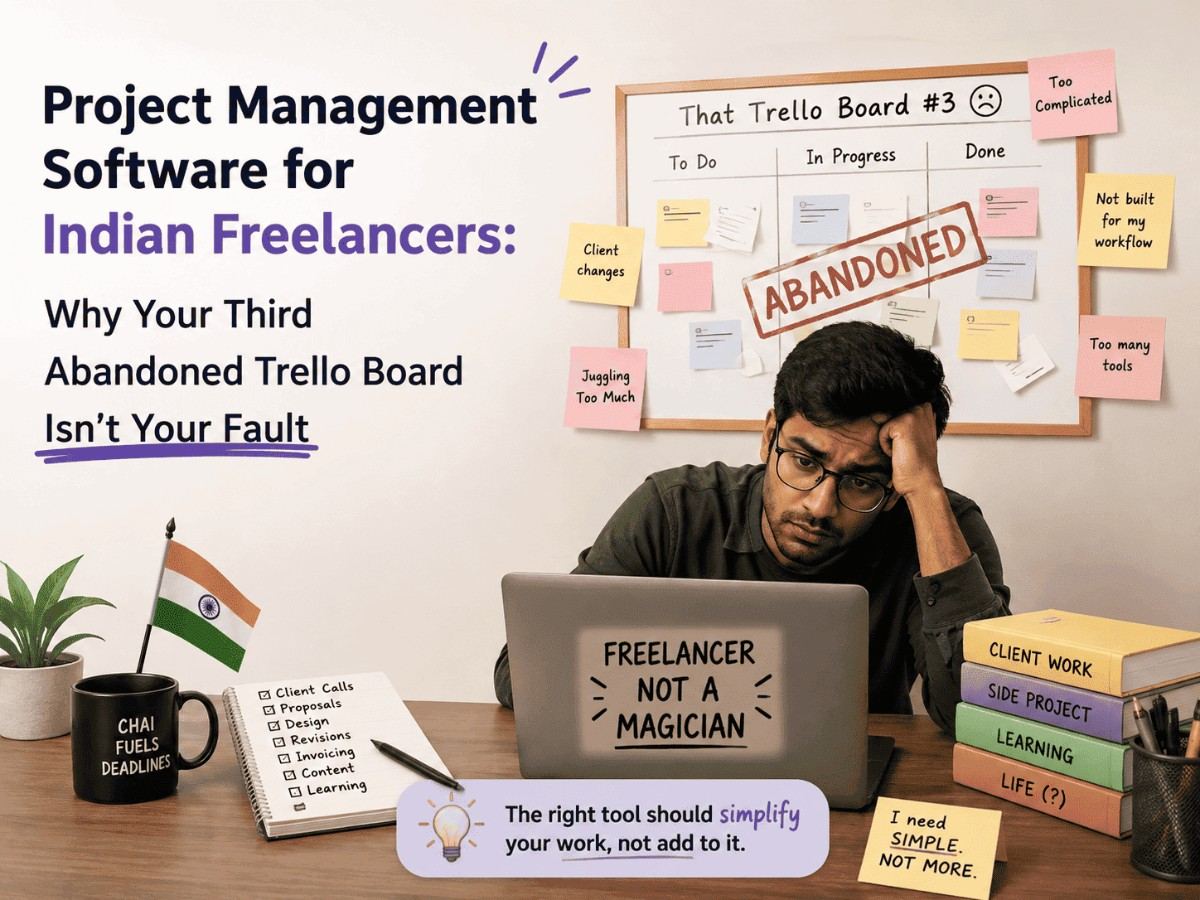
Somewhere in your accounts there's a graveyard. The Trello board from January 2024, immaculate for six weeks. The Notion workspace with the custom dashboard that took a whole Sunday. The ClickUp trial, the Asana experiment, each one built in a burst of new-year order and each one quietly dead by March, still holding cards for projects that finished a year ago.
The usual conclusion is personal: I'm just not a systems person. The actual explanation is more interesting, and it's the reason most project management software for Indian freelancers fails on schedule rather than by accident.
The board was a diary, not a machine
Think about what those tools asked of you. Finish the work, then go somewhere else and write down that you finished it. Move the card. Update the status. Tick the box.
Nothing happened when you did. The client didn't see it. No invoice moved. No approval fired. The board was a private diary of the project, and the project itself, the agreement, the payments, the sign-offs, the actual conversation, carried on in email and WhatsApp around it.
A system like that is maintained by discipline alone, and discipline is precisely the resource that vanishes in a busy week, which is the only week that matters. So the board decays, the guilt accumulates, and eventually opening the tool feels worse than not opening it. The first-hire piece in this series made the case that a record survives only when it's a by-product of the work rather than a chore after it. Your abandoned boards are that principle, proven three times at your own expense.
Built for teams, priced against you
There's a second, structural reason the standard tools misfit, and it's visible right on the pricing page.
Mainstream project management software was built for teams: many employees, one employer, internal coordination, sprints and standups and workload views. Sensible for a fifty-person product company. A freelance project is a different animal, usually two or three people, one of whom is paying the other, with a scope document and a deadline where the methodology should be.
The per-seat pricing gives the assumption away. Charging per user is rational for companies and quietly hostile to freelancers, because the extra "user" you most need in the room is the client, and paying, or making them pay, for a seat guarantees they never join. So the single source of truth ends up excluding the one person the truth is for, and you become a human bridge, copying updates out of the board into WhatsApp, which is exactly the unpaid relay work the context-switching piece priced.
What project management software for Indian freelancers actually has to manage
Strip it down and a freelance project is three layers, and the tools you've tried manage only the first.
The work: tasks, versions, deadlines. Every tool does this and it's the least of your problems.
The agreement: the signed scope the tasks descend from, the revision count, the change log. This is the layer that settles the "we said three rounds" argument, and a task board that doesn't hold the agreement leaves you fighting from memory, as the scope creep piece laid out.
The money: which task belongs to which invoice, what's been paid against it, and, because this is India, the part payment that arrived by UPI, the GST fields your bill legally needs, the 10% that vanished to TDS and must reconcile at filing time. The portal checklist piece walks that layer in detail; here the point is simpler. A project isn't managed if its money isn't, and no board built in California thinks the money is any of its business.
When one tool holds all three layers, something useful falls out: marking a task done isn't diary-keeping anymore. It updates what the client sees, moves a milestone toward its invoice, extends the record you'd point to in a dispute. The update has consequences, so it happens.
The client's eyes are the maintenance plan
Here's the piece of this I'd push hardest, because it inverts how freelancers think about staying organised.
Every private system you build will die, and every visible one will live. Not because visibility is motivating in some self-help sense, but because an audience converts upkeep from a chore into a professional obligation. You don't forget to update the status page your client checks before their Monday meeting, for the same reason you don't forget to send an invoice: someone is waiting on it.
The client-silence piece argued that a page clients can check at 11pm is what stops the anxious Monday email. Run the same fact in the other direction and it's a maintenance strategy: put the board where the client already looks, and the board maintains itself, because updating it and communicating became the same act.
This is also the honest answer to WhatsApp. Clients here will not log into a second chat app to discuss work, and they shouldn't have to. Chat stays for warmth and speed. The board is where anything with a date, a deliverable or a rupee value on it lands, ten seconds after it's settled, exactly the habit the boundaries piece prescribed.
What you can skip
A word against feature lists, since the tools compete on them.
Gantt charts model dependencies between dozens of people; you are one person, and the sequencing advice that actually fits a solo practice, one big project plus one small, is a decision, not a diagram. Sprint velocity, story points, workload heatmaps: coordination machinery for headcounts you don't have. For a practice of one to three people, the correct project management software is almost boring, tasks, status, files, scope, money, visible to the client, and anything beyond that is a hobby, not a system.
Fewer features that face the client beat more features that face you.
When a notebook is enough
Running one project at a time, finish-then-start? A notebook and a numbered invoice file genuinely cover it, and this series has said so before about adjacent tooling. The threshold to watch is the moment a client asks where things stand and assembling the honest answer takes you through four apps. That's the tell that the layers have separated, and it arrives, in most practices, somewhere around the third concurrent project.
Where Techostop fits
Techostop is built as the three layers in one place rather than a task board with aspirations. Tasks live inside a client room beside the signed scope and the invoices, so status, agreement and money stay attached to each other and the client sees the parts that concern them without a seat charge. Part payments, GST-ready billing and e-sign are native, because it's built for this market, and it starts at 299 rupees a month. Measure it the way this piece suggests measuring anything: does updating the work update the client and the money too, or have you bought another diary.
The January test
Whatever you adopt, run one test on it before the enthusiasm fades: if you stopped maintaining this tomorrow, who would notice?
If the answer is nobody, you've built another private system, and March will come for it the way it came for the others. If the answer is your client, before their Monday meeting, then for the first time the system has someone other than your discipline holding it up, and it will still be alive in a year. The boards in your graveyard didn't die because you're not a systems person. They died because no one was watching. Build the next one where someone is.