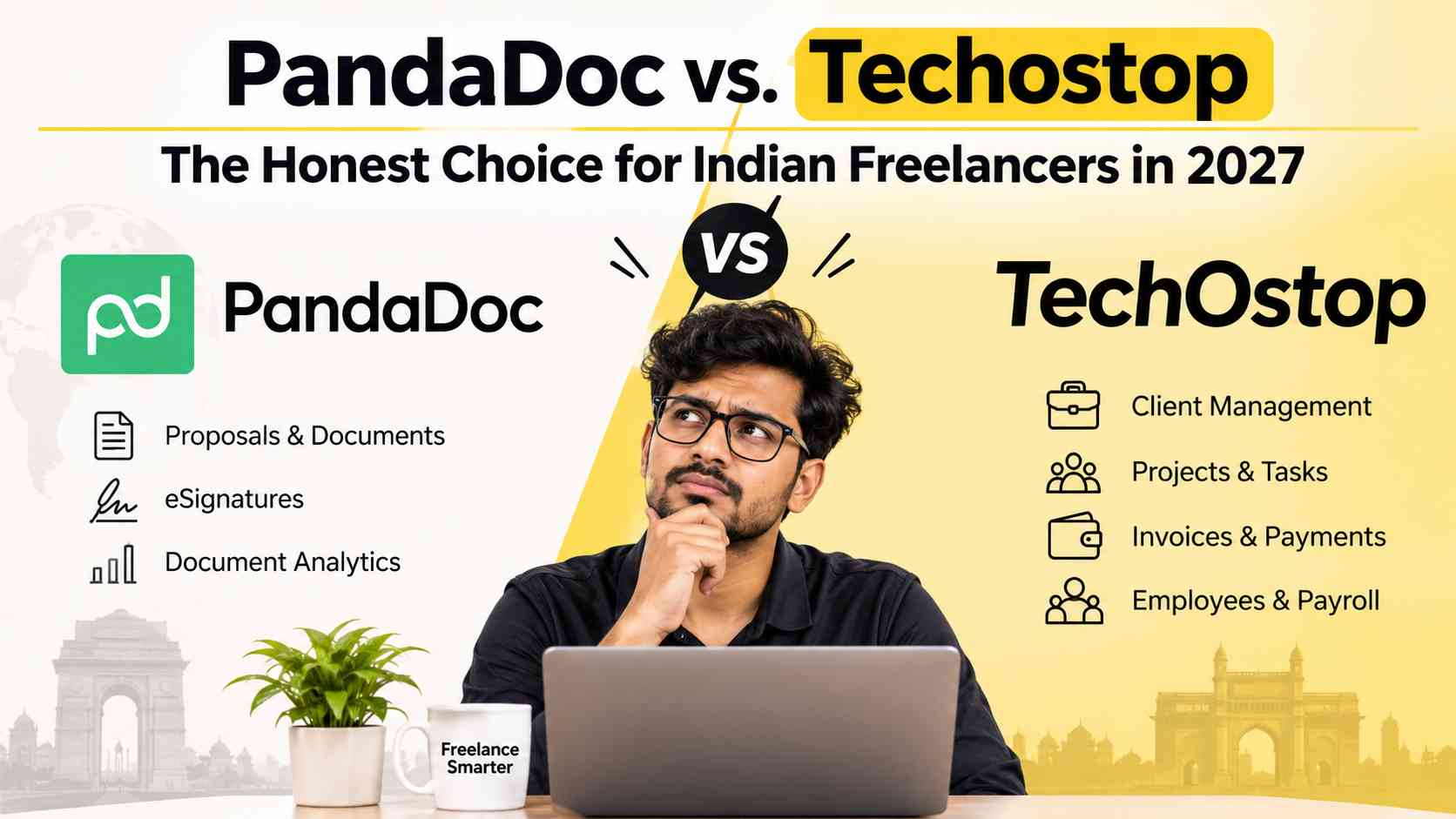
PandaDoc vs. Techostop: The Honest Choice for Indian Freelancers in 2027
November 22, 2026 | SAPTARSHI SAMANTA | 3 min read
panda doc · e-signature · techostop · business management
I’ve seen it a dozen times in freelance communities. A designer in Pune or a developer in Jaipur signs up for PandaDoc because it’s the “industry standard.” The proposal builder is slick. The templates look professional.
Then the first invoice hits. It’s in USD. The payment fails or incurs a 3% forex markup. And when it’s time to send a GST invoice to an Indian client, the whole workflow falls apart.
PandaDoc is a great product—for a US-based sales team. But for a freelancer in India, it’s an expensive square peg in a round hole. Techostop, on the other hand, is built from the ground up for how we work.
Here is the breakdown that actually matters.
The Price Reality: ₹299 vs. $19 (That’s Not the Whole Story)
On paper, PandaDoc’s entry plan looks manageable at $19/user/month (billed annually). But that’s roughly ₹1,600+ per month before you even factor in GST, forex markups, or the fact that you’re paying in a currency you don’t earn in.
Techostop’s Starter plan starts at ₹299/month. That’s not a discount; it’s a different economic model.
The per-user trap: PandaDoc charges for every seat. If you bring on a virtual assistant to help with proposals, or a partner to review contracts, your bill multiplies. Techostop prices per business, not per head. Your whole team can operate from one subscription.
For a solo freelancer, the annual math is brutal:
- PandaDoc Essentials (annual): ~$228/year ≈ ₹19,000+
- Techostop Starter: ₹3,588/year
That’s a difference of over ₹15,000—money that could be your client-acquisition budget, a new laptop fund, or just peace of mind.
The “India-First” Test: GST, Rupees, and UPI
PandaDoc will let you type “GST” into a proposal. But it won’t generate a GST-compliant invoice in rupees with multiple tax rates built in.
Techostop does. It understands that an Indian freelancer’s workflow doesn’t end at “document signed.” It ends at:
- GST invoice raised
- Payment received via Razorpay/UPI
- Records reconciled
Techostop’s invoicing handles partial payments and multi-currency (INR, USD, EUR, GBP, AUD), but the default is rupees, and the tax logic is Indian.
The All-in-One Reality Check
PandaDoc is a document automation tool. It does proposals, contracts, and e-signatures beautifully. But it stops there.
A freelancer’s client relationship lives in more places: the project tracker, the meeting scheduler, the invoice history, the file share.
Techostop bundles the client portal, e-signatures, GST invoicing, meeting booking, forms, and project management into one dashboard. When a proposal is signed, it can become an invoice. A booked meeting lands on your calendar. There is no exporting, importing, or paying for a separate scheduler.
When PandaDoc Might Still Make Sense
To be fair: if your clients are primarily US/EU-based, and you need deep native sync with Salesforce or HubSpot, PandaDoc’s Business tier ($49/user/month) is a mature, polished choice.
But if you are billing Indian clients, or a mix where rupee workflows matter, you are paying a premium for integrations you don’t use and compliance you don’t get.
The Verdict for Indian Freelancers
PandaDoc is a global sales tool. Techostop is an Indian freelance business operating system.
It respects your currency, understands your tax obligations, and prices itself for the reality of a one-person (or small team) studio. The ₹299 starting point isn’t “cheap”—it’s proportionate.